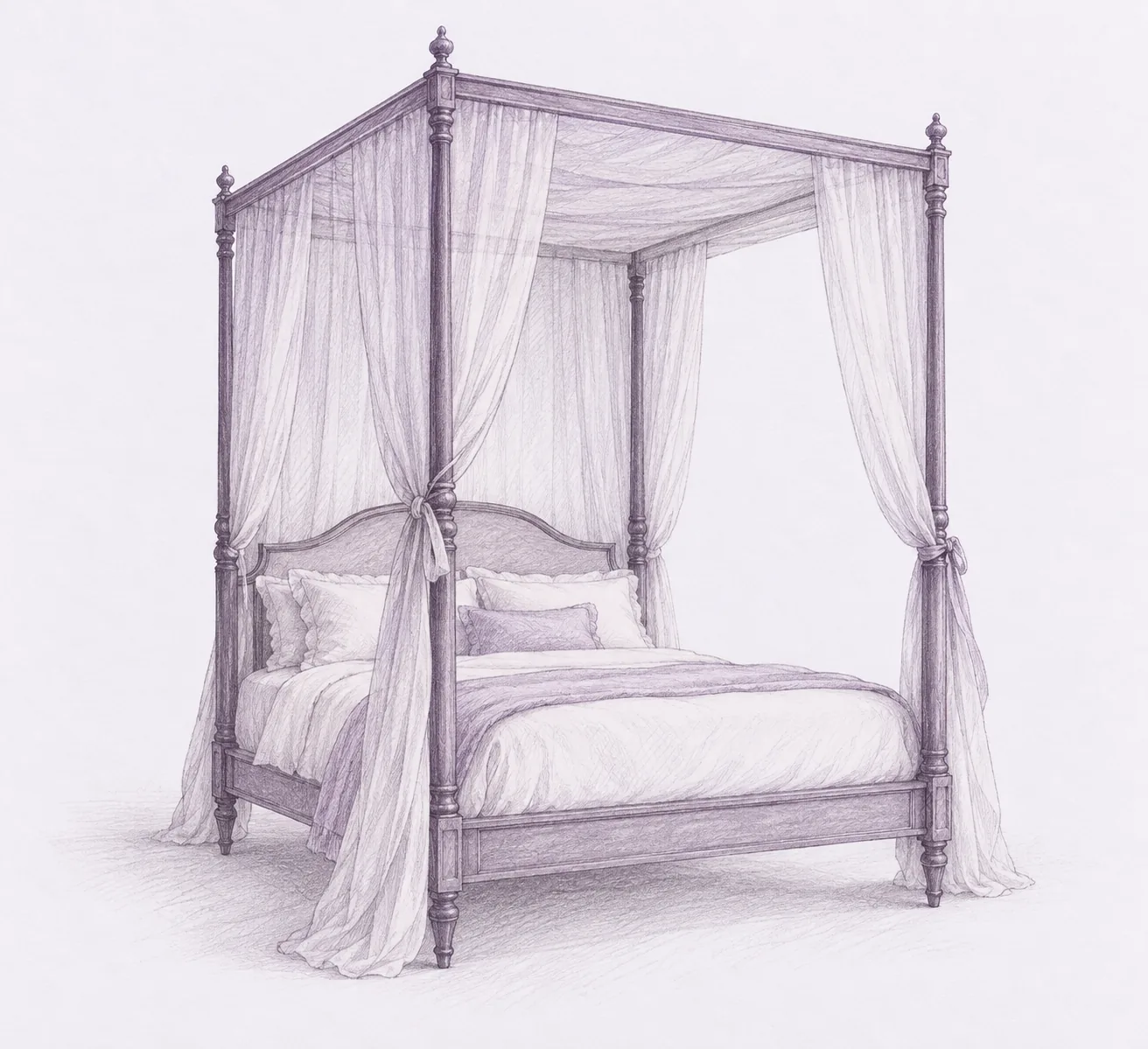
Bed With Canopy (2026): 4 Four-Poster Picks From $121
Bed frames
A bed with canopy is bought for the posts, so the deciding numbers are post height against your ceiling, the weight the posts carry, and how much clearance the base leaves underneath. This guide compares four four-poster beds from $121 to $440.
Our picks
The best bed with canopy for most homes is the Jocisland Queen Canopy Bed Frame, Velvet, Cream, because the 74.8 inch posts are load-bearing rather than decorative and the deep-tufted headboard turns a plain corner into a finished room for about $440. If the look matters more than the velvet, the AUFANK Queen Size Canopy Bed Frame delivers the same four-poster shape in metal for about $160.
A canopy bed is bought for the posts, so the deciding numbers are post height against your ceiling, the weight the posts carry, and how much room the base leaves underneath. The four beds below run from $121 to $440, and each one answers those three numbers differently. Browse the bed frame guides if you are still choosing between a fixed frame and a base that lifts, and the best adjustable bed frame guide covers bases that move, which is a different job from a canopy.
What is a bed with a canopy?
A bed with a canopy is a bed with four tall posts and a frame across the top, called the canopy, that holds curtains, lights, or a fabric top. The mattress base below is a standard platform, so the bed works with any mattress and no box spring.
The name describes the same frame as a four-poster bed. A four-poster describes the four tall corner posts, and a canopy describes the top frame that joins them. Most listings sell one structure under both names. The one thing that separates a true canopy from a decorative four-poster is the top cross beams, which are what make the frame strong enough to hang weight from.
Count the posts before you buy
A full canopy has four posts and top cross beams. A half-canopy has two posts at the head and an arch across the top, which costs less and takes less space. If you want to drape curtains on all four sides, you need the full four-post frame, not the half version. The picks here are all four-post beds.
Leave room around the posts
A queen canopy occupies the same floor space as any queen bed, about 60 by 80 inches, plus the posts at the corners. Plan for about 30 inches of walking space on at least two sides, which puts the smallest comfortable queen canopy room near 10 by 12 feet. The posts sit at the corners, so the middle stays open for storage bins to slide in from the side.
Compare the four canopy beds
Every bed here is a slatted platform that takes the mattress directly, so none needs a box spring. The difference is the post height and what the headboard brings: velvet upholstery, a charging station, or a bookshelf with drawers.
Post height is the number that sets the ceiling
Post height decides two things at once. Lower posts suit a smaller room and a lower ceiling, and taller posts give the canopy more drape above the mattress. The AUFANK is the tallest at 75.6 inches, the Jocisland is close behind at 74.8, the YITAHOME sits at 71.85, and the HIFIT is the shortest because its posts invert into the frame. Match the post to your ceiling before you match it to your style.
Jocisland Velvet Canopy is the upholstered pick
The Jocisland Queen Canopy Bed Frame, Velvet, Cream is the pick when the bed is the anchor of the room. It pairs a deep-tufted velvet headboard with reinforced cross beams and thickened posts, so the canopy frame carries the curtains you hang from it. The headboard is padded for sitting up to read, and it hides a USB-A and a Type-C port for charging without a wall brick.
The build is meant for daily use. The slat system runs anti-noise EVA pads to cut friction creaks, so nightly movement and a pet jumping on the bed do not turn into noise. It supports up to 1300 pounds and fits mattresses from 7.5 to 18 inches thick directly, with no box spring.
Two things to weigh. It is the most expensive pick here at about $440, and velvet needs a lint brush now and then to stay even. What you get for that is a bed that looks finished from the doorway, posts included.
Choose the Jocisland if: you want a tall, upholstered canopy bed that doubles as a centerpiece. Skip it if: you want the four-poster look without the velvet price.
AUFANK Metal Canopy is the value four-poster
The AUFANK Queen Size Canopy Bed Frame is the value pick and the one that looks vintage in a good way. It is built from powder-coated iron with clean lines and four canopy posts, a headboard and footboard, and steel slats. At about $160 it costs roughly a third of the velvet pick and still gives you the full four-poster silhouette.
The build is simple to live with. It goes together tool-free with all the hardware and instructions in the box, the headboard and footboard frame the mattress, and the metal side rails use additional center legs and secured slats for stability. Buyers who wanted the canopy look at a fair price tend to keep it, and reviews describe the materials as good quality for the money.
It is a metal bed, so it looks plainer than the upholstered pick, and the posts are thin next to a wood canopy. Add curtains and the frame disappears behind them, which is the point of buying a four-poster in the first place.
Choose the AUFANK if: you want the tallest four-poster look for the lowest sensible price. Skip it if: you want upholstery built into the frame.
YITAHOME Canopy is the budget metal pick
The YITAHOME Canopy Bed Frame, Metal, Queen is the lowest price here and the pick when you want the canopy shape plus a couple of extras. It is a 71.85 inch metal four-poster with a 14 inch platform, strong metal slats, and a center bar, and it brings a charging station and an LED light strip in the headboard. The overall dimensions are 83.26 by 60.82 inches, so it sits a little wider than the mattress.
The base is the useful part. The 14 inch platform leaves about 12 inches of storage clearance, which fits a standard tote, and the center bar carries non-slip foam tape to keep the slats quiet. The double cross rails near the headboard and the center legs add stability to the tall frame.
Two small things to plan for. Delivery adds about $15, which narrows the price gap with the AUFANK, and the 800 pound rating is the lowest of the four, so a heavier sleeper should size up to the Jocisland. For a typical bedroom, 800 pounds covers the load with room to spare.
Choose the YITAHOME if: you want a low-cost canopy bed with under-bed storage and charging. Skip it if: you want the highest weight rating, or the tallest posts.
HIFIT LED Canopy is the kids and storage pick
The HIFIT Full Size LED Canopy Bed Frame is the pick for a kid, teen, or guest room that needs to grow. The four posts unscrew, so the same frame becomes a canopy bed now and a plain upholstered platform later. It is Full size rather than queen, which suits a smaller room and a single sleeper.
The extras are aimed at a young room. The headboard is a two-tier bookshelf for books, toys, and a tablet, and the LED strip runs 16 million colors through an app or a remote, with a timed mode that works as a nightlight. The two drawers carry safety locks and roll on silent casters, and a charging station adds three USB ports and one USB-C.
Two things to weigh. Setup is the longest of the four and the box is heavy, so plan for a second person, and the Full size leaves a couch-sized footprint rather than a queen. For a kid's room, that smaller footprint is usually the reason to pick it. If you would rather skip the posts, the full size bed with frame guide lists plain platforms for the same mattress size.
Choose the HIFIT if: you want a canopy bed for a kid or teen that converts to a platform. Skip it if: you need a queen or king, or you want a fast, simple build.
How tall is a canopy bed, and what ceiling does it need?
Most canopy beds stand 71 to 76 inches tall at the posts. Add a 10 inch mattress and the top of the canopy sits near 81 to 86 inches, so a standard 8 foot ceiling clears it with about 10 to 15 inches to spare. Measure the exact spot before you order.
Measure the posts against your ceiling
A standard ceiling is 8 feet, or 96 inches. The tallest pick here, the AUFANK at 75.6 inches, leaves close to 20 inches of bare post below a flat 8 foot ceiling before you add a mattress, and the shortest, the YITAHOME at 71.85 inches, leaves a little more. A sloped or dormer ceiling cuts that margin, so check the lowest point over the bed, not the average.
Give the canopy a little air on top
If you plan to drape curtains or fairy lights, leave a few inches of clear space above the top frame so the fabric or strand does not press the ceiling. A canopy is meant to breathe at the top, and a tight fit turns a soft drape into a stretched panel.
Canopy bed vs four-poster bed: what is the difference?
They are the same structure under two names. A four-poster bed names the four tall corner posts, and a canopy bed names the frame that joins the posts across the top. Most sellers list both terms on one product, so a "four-poster canopy bed" is not a contradiction.
The practical difference is whether the top frame exists. A true canopy has cross beams across the top, which is what makes the posts load-bearing and lets you hang curtains or lights. A four-poster without the top frame is a decorative headboard-and-posts shape, and hanging weight from it is not safe. Every pick here has the top frame.
How do you hang curtains on a canopy bed?
You hang curtains by looping or clipping panels over the top cross beams and letting them fall to the floor. The catch is quantity: a canopy takes double the panels of a normal rod, because each post needs its own drape if you want all four sides covered.
Start with the post height, then the panel length
Pick the panel length from the floor to the canopy bar, not from the mattress. An 84 inch panel reaches the floor on a standard 74 inch post, and a 96 inch panel suits a taller king canopy. If you want a pooled look, add 4 to 6 inches. Measure the drop from the top frame to the floor before you buy, because a short panel that stops at the mattress looks like a mistake.
Who should skip a canopy bed
Skip it if the ceiling is low or sloped. A canopy needs vertical room above the mattress. In a room with a dormer or a 7 foot ceiling, the tallest posts here will feel cramped, and a plain platform is the better buy.
Skip it if you want an adjustable base. A motorized base is its own foundation and the head and feet lift, which does not work under a fixed canopy frame. The best adjustable bed frame guide covers bases that move.
Skip it if you want the lowest price and no posts. The same money buys a plain queen platform with more under-bed clearance, and the king size bed frame guide runs that list for a larger mattress. A canopy is a style purchase on top of the frame, so buy it only when you want the look.
Bottom line
The best bed with canopy for most bedrooms is the Jocisland Queen Canopy Bed Frame, Velvet, Cream, because the tall posts are load-bearing and the upholstered headboard makes the bed a centerpiece, for about $440. The AUFANK Queen Size Canopy Bed Frame is the value pick for the four-poster look, the YITAHOME Canopy Bed Frame is the lowest price with storage and a charging headboard, and the HIFIT Full Size LED Canopy is the pick for a kid or teen room that needs storage and a frame that converts.
Match the post height to your ceiling, count four panels if you want curtains on all sides, and skip the box spring so the mattress stays at a workable height. A canopy bed is a frame you look at as much as you sleep on, so buy the one whose height and finish you will still like in five years.
Frequently Asked Questions
What is a bed with a canopy?
A bed with a canopy is a bed with four tall posts and a frame across the top, called the canopy, that supports curtains, lights, or a fabric top. The posts and top frame are usually metal or wood, and the mattress base below is a standard platform. Some canopy beds also add a headboard, storage drawers, or charging built into the frame.
What is the difference between a canopy bed and a four-poster bed?
They are the same structure with two names. A four-poster bed describes the four tall corner posts, and a canopy bed describes the frame that joins the posts across the top. Most listings sell both under one name. If the top cross beams are missing, it is a four-poster without a canopy and the posts are decorative rather than load-bearing.
How tall is a canopy bed, and what ceiling does it need?
Most canopy beds stand 71 to 76 inches tall at the posts. A 74.8 inch post on a 10 inch mattress puts the top of the canopy near 85 inches, so a standard 8 foot ceiling (96 inches) clears it with about 11 inches to spare. Measure the ceiling in the exact spot where the bed goes, because a sloped or dormer ceiling can cut that margin fast.
What is the best canopy bed?
The Jocisland Queen Canopy Bed Frame, Velvet, Cream is the best pick for most bedrooms. The 74.8 inch posts are structural, the deep-tufted headboard carries USB-A and Type-C, and the 1300 pound rating covers two adults with room to spare. The AUFANK metal four-poster is the value pick, and the YITAHOME is the lowest price with a charging headboard.
How many curtain panels does a canopy bed need?
A queen canopy needs four panels to drape all four posts, or two extra-wide panels if you want a fuller look with fewer seams. A standard rod takes two panels, so budget for double when you buy curtains. Panel length should reach the floor; 84 inch panels suit most posts, and 96 inch panels suit a taller king canopy.
Do canopy beds need a box spring?
No. Every pick here is a slatted platform, so the mattress rests on the slats directly and a box spring would only add height and flex. Canopy beds already sit tall, so skipping the box spring keeps the mattress at a workable height and saves you the cost of a foundation you do not need.
Are canopy beds sturdy, or do the posts wobble?
A well-built canopy bed is sturdy, and the weight rating is the number to check. The Jocisland is rated to 1300 pounds and the YITAHOME to 800, which means the posts and cross beams carry real load rather than standing as decoration. Reinforced cross beams and a center support bar are what keep a canopy bed from swaying, so look for both in the description.
Can you remove the posts from a canopy bed?
It depends on the frame. The HIFIT pick here ships with four removable posts, so the same bed works as a canopy for a kid's room now and a plain upholstered platform later. Most metal and velvet canopy beds build the posts into the frame, so check the listing before you count on converting the bed later.
Are beds with storage a good idea?
Yes, when the base leaves enough clearance. The YITAHOME and the HIFIT each leave about 11 to 12 inches under the frame, which fits a storage tote, while the upholstered Jocisland sits lower. Storage under a canopy bed works best when the posts are at the corners and the middle stays open, so bins slide in from the sides without hitting a leg.