Best Hybrid Mattress Under $1000 (2026): Pocket Coil Queens From $190
Mattress types
A hybrid under $1000 buys a real pocket coil core plus a foam comfort layer. The three here run $190 to $300, and each one puts its money into the coil unit rather than the cover.
Our picks
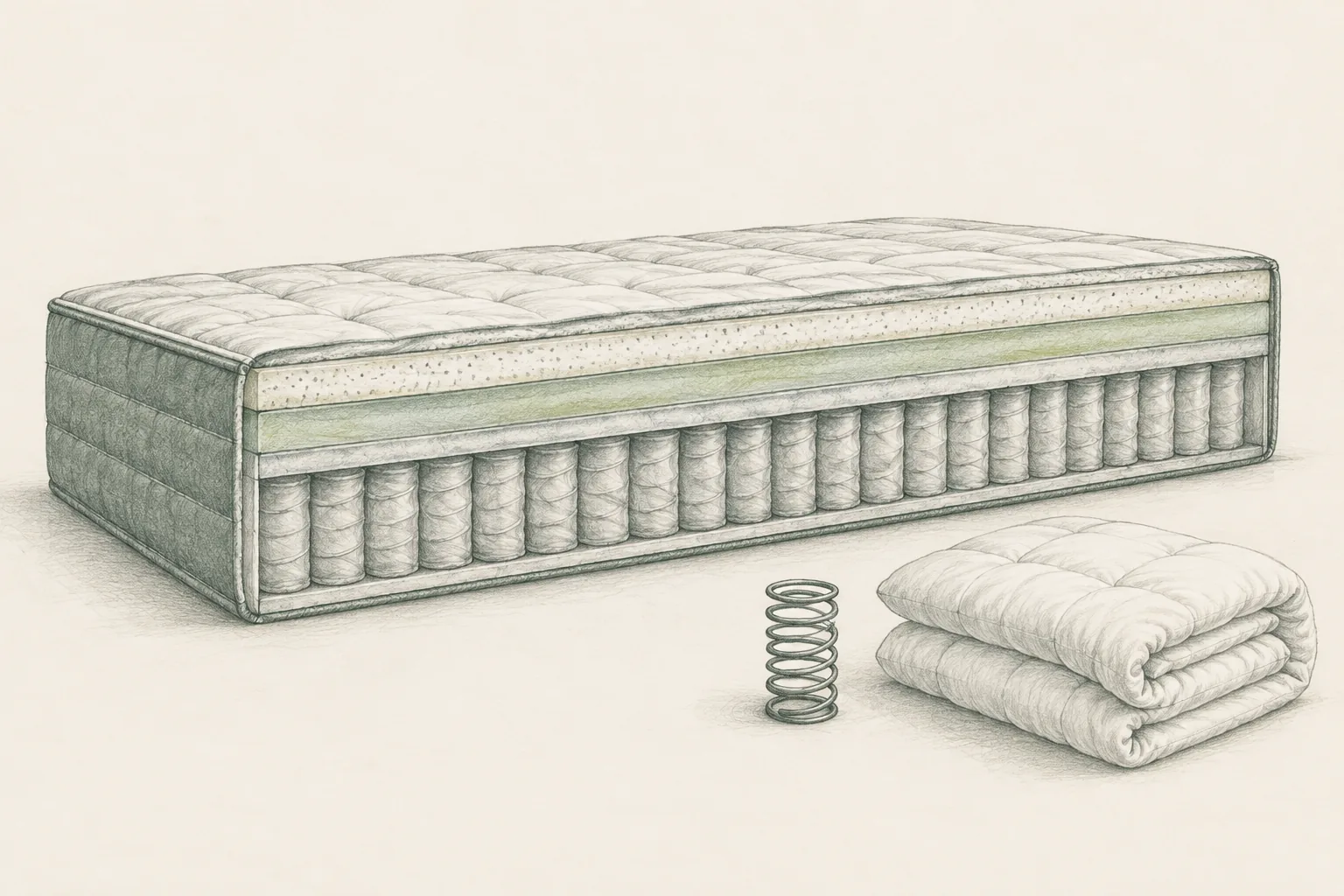
A hybrid mattress is a foam comfort layer sitting on individually wrapped pocket coils. That coil core does three things foam cannot. It lets air through the bed, it pushes back faster when you change position, and it spreads the load so the middle of the mattress does not dip. Everything else is a detail.
The pleasant surprise in this budget is that you do not need to spend $900 to get those three things. The hybrids worth buying under $1000 cluster between $200 and $400, and the three picks here each put their cost into the coil unit rather than the cover.
Browse the rest of our mattress type guides if you are still weighing foam against hybrid. For two sleepers who disturb each other, the best hybrid mattress for couples guide goes deeper on motion isolation. If your budget is the deciding factor across every build, the best mattress under $1000 guide covers the wider bracket, including foam and budget picks.
What a hybrid gets you that foam cannot
Airflow. Air moves through the spaces between coils. On a solid foam mattress, heat collects in the middle of the block and has nowhere to go. That is the single biggest reason a hot sleeper who hates foam ends up on a hybrid.
A faster pushback. Foam compresses slowly and returns the same way. Coils resist right away. If you change position several times a night, or you have trouble turning over, a hybrid responds instead of holding you in the dent you just made.
Even support across the middle. Pocket coils share load with their neighbors. A foam base compresses directly under the heaviest point. That is why a hybrid holds the lumbar level longer for a couple whose weights differ.
A firmer edge, when it is built in. Perimeter coils and edge foam give you back the outer few inches of the mattress. On a soft foam bed, that edge gives way.
Why the good hybrids under $1000 cluster near $250
Coil units are not the expensive part of a mattress. Foam density is, and so is whatever sits on top of the mattress. A 12 to 14-inch hybrid with a mid-grade foam layer and no pillow top lands around $200 to $400, and that build has everything the job needs.
What pushes a hybrid past $1000 is usually one of three things. A thick plush euro top that adds two or three inches of soft foam. A brand with showrooms and advertising. Or a coil unit tuned for a specific feel, which is real but is a refinement rather than a requirement.
The practical takeaway is simple. If your budget is under $1000, spend $250, not $900. Put the difference toward a frame, a decent protector, and breathable sheets, all of which change how the bed sleeps.
Compare the three hybrids
All three are queen size, all three ship compressed in a box, and all three are fiberglass free, which matters more than it should at this price. None of them needs a box spring, so a slatted platform frame is the only foundation you need.
Grbsy 14 Inch 7-Zone is the best all-rounder
The Grbsy 14 Inch Queen Hybrid Mattress is the pick when one bed has to work for two people with different sleep positions. The 7-zone coil layout varies support from the head end to the foot, so the shoulder area is softer than the waist, and the hip area is firmer than both.
Cooling is the second strength. The cover has a graphene infusion, the memory foam is gel-infused, and the coil core gives heat a path out of the bed. Owners report sleeping through the night without waking warm, which is the whole point of choosing a hybrid over foam.
Reinforced perimeter coils and edge support foam expand the usable surface, so sitting on the side to put shoes on does not collapse the mattress. It is not a hotel bed edge, but it holds.
The 365-night trial is the safety net on a bed you have not laid on. The one practical note is weight. Bring help when it arrives, and let it settle on the frame for a few hours before the first night.
Choose the Grbsy if: you want one medium firm hybrid that handles side, back, and combination sleepers. Skip it if: you want a genuinely firm bed, or you need something light enough to move alone.
BedStory Firm 14 Inch is the pick for back and stomach sleepers
The BedStory Firm Queen 14 Inch Mattress is the only genuinely firm pick here. It pairs 38D fusion memory foam with 2.3 mm pocket springs and an edge reinforcement, and the result holds the hips up rather than letting them sink.
If you sleep on your back or your stomach, that is exactly what you want. A firm surface keeps the lower back from arching and stops the midsection from dropping into the bed, which is the most common cause of morning back stiffness on a soft mattress. The zoned coils put the support where the weight lands.
The build is fiberglass free and certified, and owners report no off-gassing, which is unusual at this price. Motion isolation is strong enough for a couple where one partner moves around.
The listing is on a limited-time deal that runs through September 26, so this is a fair week to buy if the firm feel is what you want.
Choose the BedStory if: you sleep on your back or stomach and want real firm support. Skip it if: you are a side sleeper who needs shoulder cushioning, or you want a plush top.
Quarota 12 Inch is the budget hybrid
The Quarota Queen Mattress 12 Inch Hybrid is the cheapest way into a real pocket coil bed here. It puts individual springs under several foam layers, wraps the whole thing in a breathable air-layer fabric, and keeps the price under $200.
For a first apartment, a guest room, or a bedroom where the mattress will be replaced in a few years anyway, this is a sensible spend. It sleeps cooler than all foam, it isolates motion better than an innerspring, and it fits any standard frame without a box spring.
The trade is depth. Twelve inches leaves less foam between you and the coil unit, so a heavier sleeper feels the springs earlier and a very soft feel is not available here. If you weigh more than about 220 pounds, the 14-inch Grbsy is worth the extra $70.
Choose the Quarota if: you want a real hybrid at the lowest price and you weigh under about 220 pounds. Skip it if: you want a thick comfort layer or a plush pillow top.
Coils, gauge, and what the zones really change
Gauge is wire thickness, and lower numbers mean thicker wire. Twelve gauge is a solid target for a budget hybrid. Thicker wire holds its shape longer under repeated load, which is the difference between a bed that feels the same in year three and one that has a dip.
Coil count matters less than the count of good coils. A queen with 800 to 1,000 pocket coils is well built. A listing that brags about 2,000 coils is usually using very thin wire, which compresses sooner.
Zones change support along the length of the bed, not across it. A 7-zone bed varies firmness from the shoulder area to the hip area. That is real and useful for side sleepers, because the shoulder needs to sink further than the waist. It is not a gimmick, but it is also not a replacement for picking the right overall firmness.
Pocket coils are individually wrapped, which is what isolates motion. Connected coils share movement across the whole mattress. If you sleep with a partner who moves, pocket coils are the reason a hybrid can feel as quiet as foam.
How to spot a foam bed with a token coil layer
Not every mattress labeled hybrid has a coil unit worth having. Three checks expose the weak ones.
Height. Under 10 inches leaves no room for a supportive coil unit plus a comfort layer. Six-inch hybrids exist, and they are foam beds with a spring garnish.
Comfort layer thickness. If the listing names three or four foam layers and does not describe the coil unit at all, the foam is doing the work.
Edge behavior. A real hybrid holds its shape when you sit on the side. A token coil layer collapses because the perimeter springs are thin and unreinforced.
The firmness story. A hybrid with a real coil core should feel responsive, not sluggish. If the listing describes deep sink and slow contouring, that is a foam mattress.
Who should skip a budget hybrid
Skip it if you want the deepest possible contour. Memory foam wins on pressure relief for a shoulder or a hip. A hybrid trades some of that for support and airflow.
Skip it if you weigh over about 300 pounds. At that weight, coil wire thickness and edge reinforcement matter more than anything else here. Step up to a bed with a documented higher weight rating and a reinforced perimeter.
Skip it if you want an adjustable split. A single-piece hybrid does not bend into separate halves. That job needs a split king setup and two Twin XL mattresses.
Skip it if $190 is already a stretch. A cheap foam bed at $150 is a worse mattress in every way that matters here, but it is not a worse decision if the budget genuinely stops there. Buy what you can replace in three years without resenting it.
Bottom line
The best hybrid mattress under $1000 is a medium firm queen with a real pocket coil core, and the Grbsy 14 Inch Queen Hybrid Mattress is the one we would buy at about $260. Choose the BedStory Firm Queen 14 Inch Mattress when you want genuine firm support for back and stomach sleeping, or the Quarota Queen Mattress 12 Inch Hybrid when the budget caps out near $190.
You do not need to spend $900 to get pocket coils, airflow, and motion isolation. You need to spend it in the right place, which is the coil unit and a mid-grade foam layer, and stop before the plush euro top and the brand story start adding hundreds to the price.
Frequently Asked Questions
What is the best hybrid mattress under $1000?
The Grbsy 14 Inch Queen Hybrid is the best all-rounder. It is medium firm with a 7-zone pocket coil core, cooling gel foam, and reinforced edges, and it costs about $260. Choose the BedStory Firm 14 Inch if you want a truly firm surface for back and stomach sleeping, or the Quarota 12 Inch if $190 is the ceiling.
Do you need to spend $1000 to get a good hybrid mattress?
No. The hybrid builds worth buying at this budget sit between $200 and $400. Below that, the coil unit gets thin and the foam does the work, which is just a foam mattress with extra steps. Above $400 you are paying for a brand, a thicker comfort layer, or a showroom, not for better springs.
What is a hybrid mattress, exactly?
A mattress with a pocket coil support core under a foam comfort layer. Innerspring mattresses use connected coils, which transfer motion across the bed. Pocket coils are individually wrapped and move on their own, which is what gives a hybrid its motion isolation and its zoned support.
Are cheap hybrid mattresses any good?
The well-built ones are, and the coil gauge tells you which ones those are. A 12-gauge or thicker coil wire holds its shape longer than thin wire, and a 12-inch or 14-inch height gives the coil unit room to work. A 6-inch bed with a token coil layer is where the budget hybrid reputation for sagging comes from.
How many coils should a hybrid mattress have?
Around 800 to 1,000 pocket coils for a queen is a solid target. More coils is not automatically better, because thinner wire can hit a bigger number by using more, narrower springs. Look for the coil count alongside the coil gauge and the height of the support core.
Do hybrid mattresses sleep cooler than foam?
Yes, generally. Air moves through the coil unit in a way it cannot through a solid foam block, so heat has somewhere to go. A hybrid still has a foam comfort layer, so it is not a cold bed. It is cooler than the same firmness in all foam, which matters most for hot sleepers.
What firmness is best for a hybrid mattress?
Medium firm suits the most people. A hybrid with a coil core already feels firmer than all foam at the same rating, because the springs push back faster than foam compresses. If you want a genuinely firm bed for stomach sleeping, choose one labeled firm rather than hoping medium firm will feel firm enough.
How long does a hybrid mattress in a box take to expand?
A few hours to be usable and 24 to 72 hours to reach full height. Pocket coils recover faster than thick foam, so most hybrids are sleepable the same day. Give it three nights before you judge the firmness, and a week before you decide it is wrong.
Is a hybrid better than memory foam for back pain?
It depends on where the pain comes from. A hybrid keeps the lumbar level and lets air through, which helps a back sleeper who runs warm. All foam contours the shoulder and hip more deeply, which helps pressure-driven pain. The best mattress for back pain guide breaks that choice down.
Do cheap hybrid mattresses sag quickly?
The coil unit is usually the last part to fail. The foam comfort layer softens first, which is what turns a supportive bed into one with a dip where you sleep. Keeping the bed on a flat, firm frame and rotating it every few months is what buys the extra years.