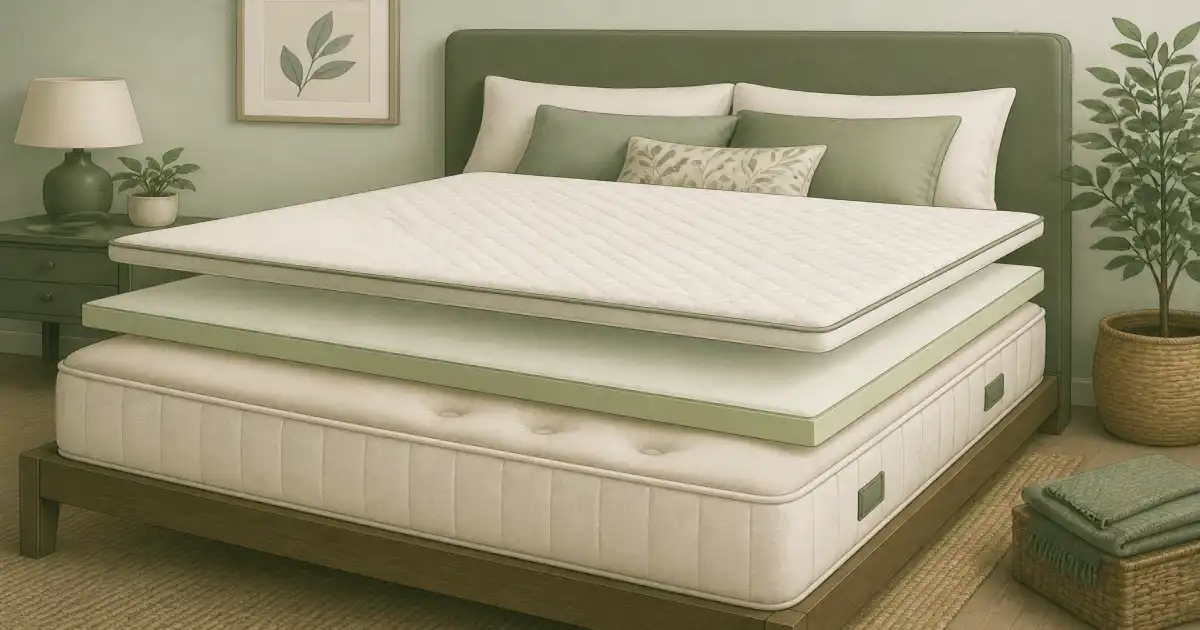
Best Mattress Topper for a Soft Mattress (2026): Firm It Up Without Replacing It
Mattress toppers
A topper can firm up a soft mattress that is still level. It cannot fix a valley. Here is the density that stops hip sink, what each option costs a night, and how to tell which problem you have.
Our picks
For most people whose mattress is too soft, the best mattress topper for a soft mattress is the ViscoSoft 3 Inch Select High Density Mattress Topper. At 3+ lb/ft³ it carries roughly twice the foam density of the cheap toppers that give the category a bad name, and density decides whether the layer holds your hips or flattens under them.
The mistake is shopping for the word firm. A topper listing can call itself firm, extra firm, or orthopedic and still be cut from 1.5 lb foam that packs down in a month. Density is the number that tells you what will happen.
Sort out which problem you actually have before you buy anything. That is the whole decision on this page, and it is the step most shoppers skip.
Browse the rest of the mattress topper guides if you are still comparing builds. The best mattress topper pillar covers the whole category if you have not chosen a material yet.
Which topper actually firms up a soft mattress?
Buy the densest foam you can afford, ideally 3 lb/ft³ or more, in a two or three inch layer. High-density foam resists compression, so your hips stay closer to level with your shoulders instead of sinking into a bowl.
That single number separates a layer that helps from one that makes the bed feel heavier.
Will a mattress topper help a too soft mattress?
It helps when the bed is flat and the softness sits in the comfort foam. Press the middle with the flat of your hand. If the surface is still level, a dense topper buys you a firmer sleep surface. If there is a dip you can see from the doorway, it will not.
What thickness should a firming topper be?
Two or three inches is the useful range. Any thinner and you barely change the feel. Any thicker and you raise the bed enough that standard sheets fight the corners, and a deep soft layer can add sink instead of subtracting it.
What if you want the opposite, a softer surface?
Then you have a firm bed, and a dense topper is the wrong purchase. Use our mattress topper for a firm mattress guide instead. It covers the plush layers that soften a hard surface, which is a genuinely different job.
Check the bed and the base before you spend anything
Two checks take five minutes and save a wasted purchase.
Does the mattress still sit level?
Lay a straightedge or a long ruler across the bare mattress where you sleep. If it rocks or you can slide a finger under the middle, the support core has compressed. Foam on top will not bring it back, and you will be stacking a good layer on a dead bed.
Is the base doing its job?
Slats that flex, a bowed platform, or a broken box spring all make a decent mattress feel soft. Push down on the base with one hand. If it gives, fix that first. It costs far less than a topper and it is the actual problem.
Once both checks pass, a topper is a sensible fix. If either fails, the section further down on replacing the mattress is the one you want.
The two toppers that hold their shape
Both picks are dense enough to change the feel of a soft bed without turning it into a board, and both are covered for five years. They differ in how much they change the bed and how they feel when you move.
Does a high-density topper smell when it arrives?
Usually for a day or two. Owner reviews are split on odor, with 317 positive and 279 negative mentions on the listing, and one tester found a strong smell that cleared completely after 48 hours. Air it flat in the room before you sleep on it.
Best for firming up: ViscoSoft 3 Inch Select High Density
Three inches of 3+ lb/ft³ foam is a real change to a soft bed, not a cosmetic one. It is the difference between a bed that swallows you and a bed that holds a line from shoulder to hip. Wirecutter has named this Select High Density topper its best memory foam mattress topper for 3 straight years, which is the strongest durability record here.
A 30-night measured test found the surface stayed within 2°F of a 68°F room, and at day 30 the foam still measured a full three inches with no body impressions. A separate two-month test recorded no dips after 60 nights, including the edge the tester sat on every evening.
The warranty is worth reading because it defines failure for you. It covers sinkage and body impressions of 1.5 inches or more for five years, and it voids on repeated stains. That is why a waterproof protector belongs in the budget from the start.
Firmness is medium-firm, not rock hard. Stomach sleepers should look elsewhere, because a dense layer holds the hips a little high for that position. Back sleepers and heavier side sleepers get the most from it.
Choose the ViscoSoft if: your bed is soft but level, and you wake with your lower back aching. Skip it if: you sleep on your stomach, or you are a light side sleeper who needs shoulder give.
Springier alternative: Pure Green Soft Latex 2 Inch
This is the smaller change of the two. Sleepopolis measured an 8-out-of-10 bed dropping to 5.5 after the soft two-inch went on, and a 6.5 bed dropping to 4.5, which is a change of about 2 to 2.5 points. That is meaningful, but it is not the same as a dense three-inch foam layer.
It is a good fit when the softness you dislike is the surface feel, not the support underneath. The natural latex has no chemical off-gassing. There is a light rubber scent out of the box that most owners put at 24 to 48 hours.
Because latex is springy, it moves with you and it does not trap heat the way gel foam does. Gel memory foam delays heat for 30 to 60 minutes before it warms; latex stays temperature neutral. If you run hot, that difference matters more than any cooling cover.
Choose the Pure Green if: you want a moderate firmness change and easy movement. Skip it if: you need a hard stop on hip sink, or you cannot lift a 24 lb slab.
What does this cost a night?
Warranty length is the fairest way to compare a topper with a cheap one, because both feel fine on night one. Spread the price across the covered life and the gap closes.
The budget lane is genuinely cheaper per night. What it does not give you is density. If a $52 topper packs down or slides in year one, you buy a second one and the arithmetic flips, because the cheap lane is where replacement actually happens.
When the mattress, not the topper, is the problem
A topper will not save a bed with a hammock dip you can spot from across the room, and it will not fix a broken foundation. If your hips still fall into a valley after a dense three-inch layer, the support core is finished.
Couples hit this in different ways. One partner wants more support, the other wants plush, and a firming topper looks like a compromise. It is a reasonable compromise for a soft but flat bed. It is a bad one for a collapsing bed, because both people will still be sleeping in a dip.
If you are also shopping for a heavier body, our mattress topper for heavy people picks cover the layers that survive real load. Density matters even more there.
Bottom line
A topper is worth trying when the mattress is too plush but still level. Choose dense foam for the clearest change, or soft latex when you want a smaller shift and easier movement. Measure the bed first, keep firm-topper shopping and firm-mattress softening on their own guides, and put a protector over whatever you buy so the warranty stays valid.
Frequently Asked Questions
Will a mattress topper help a too soft mattress?
Yes, if the bed is still level and the softness comes from the comfort layers. A dense topper adds a firmer surface over the foam and slows how far your hips drop. It will not help a mattress that already has a visible dip or a broken support core.
What is the best mattress topper for a soft mattress?
Start with the ViscoSoft 3 Inch Select High Density Topper. Its foam is rated 3+ lb/ft³ against the 1.5 to 2 lb/ft³ of a cheap topper, and density is what decides whether the layer holds your hips or flattens under them. The 5-year warranty covers impressions of 1.5 inches or more.
How thick should a topper be to firm up a soft bed?
Two or three inches is the useful range. Thickness is not the same as support, though. A soft three-inch topper can add more sink than a dense one-inch layer, so read the density before the depth.
Can a topper make a mattress less bouncy?
Dense memory foam usually reduces bounce and slows the surface down. Latex stays springy and is easier to turn on. That is the trade: more support usually means more resistance when you move.
What if the bed is too firm and I want it softer?
That is the opposite job, and it belongs on our mattress topper for a firm mattress guide. Buying a dense foam layer for a hard bed makes it harder.
Is this the same as a firm mattress topper?
Close, but not identical. This page is for a bed that already feels too soft. Our best firm mattress topper guide ranks firm layers by name, including the foam density, for shoppers comparing products.
Do I need a protector over a topper?
Yes. The maker's warranty voids on repeated stains, and foam absorbs sweat and spills. A waterproof protector that fits the new bed height keeps the topper clean and keeps the coverage in place.
When should I replace the mattress instead?
When you can see a permanent valley, feel broken coils, or the bed has stopped supporting you after a topper. A topper can hide a small dip for a while. It cannot rebuild a support core.